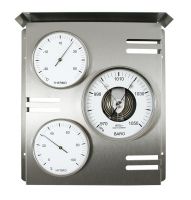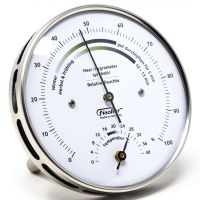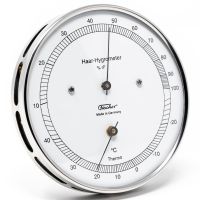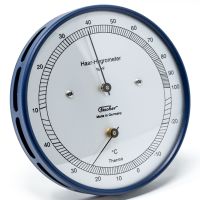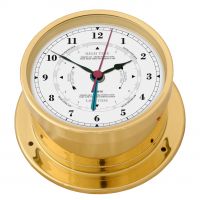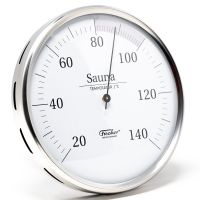

Mechanics is fascinating because it demonstrates just how much can be achieved using only force, motion, and material properties—without any electronics at all. The best proof of this comes from analog measuring instruments such as spring balances, barometers, and classic moving-coil instruments. They operate reliably, precisely, and entirely without electricity. The key principle behind them is that mechanical energy is converted directly into a measurable motion without the need for electrical energy.
Why analog measuring instruments work without electricity – the short answer
Analog measuring instruments do not require electricity because they convert physical quantities directly into mechanical movements. A spring extends, a pointer rotates, a piston moves—and this movement is displayed on a scale. No electronics, no sensors, no power source.
The basic principles: Mechanics as nature’s translator
Mechanical measuring instruments are based on three fundamental principles of physics:
• Force transmission – Forces act directly on components such as springs, levers, or diaphragms.
• Elasticity – Materials deform in proportion to the applied force.
• Equilibrium – A pointer stops where forces balance each other out.
These principles are universal and require no external energy. Nature provides the force; the device provides the reading.
Example 1: The spring balance – force becomes a reading
A spring balance is the prime example of a unpowered measuring device.
Here’s how it works:
1. The weight pulls downward → force acts on the spring.
2. The spring stretches in proportion to the force (Hooke’s law).
3. The deflection is indicated by a pointer or a scale.
The energy that powers the device comes from the weight itself. It doesn’t need a battery because gravity does the work.
Example 2: The barometer – air pressure moves a diaphragm
An analog barometer measures air pressure using a thin metal diaphragm that bulges or flattens in response to changes in pressure.
• High air pressure → The diaphragm is pushed inward.
• Low air pressure → The diaphragm bulges outward.
• A lever mechanism amplifies the movement and moves a pointer.
Here, too, the energy comes from the environment—the air pressure itself.
Example 3: Moving-coil instruments – Electricity becomes mechanically visible

These devices are particularly fascinating because they display electrical quantities without requiring an external power source.
Here’s how it works:
• A small current flows through a coil.
• The coil generates a magnetic field.
• This magnetic field interacts with a permanent magnet.
• The resulting force rotates the coil → the pointer moves.
The key feature: The current being measured is also the energy source for the pointer’s movement. The device therefore does not require its own power supply.
Why mechanics is so reliable
Mechanical measuring instruments offer several advantages that modern digital devices do not always provide:
• Ruggedness – less prone to failure, no electronics, no software errors.
• Independence – function in cold, hot, or humid conditions, or during a power outage.
• Direct measurement – no conversion to digital signals, no distortion caused by electronics.
• Long service life – decades of use without maintenance.
This is why analog devices remain indispensable to this day, especially in safety-critical sectors such as aviation, shipping, and laboratories.
The underlying reason: Mechanics require no “interpretation.”
Digital devices must measure, convert, interpret, and display. Mechanical devices directly indicate what is happening.
Examples:
• A spring extends → force.
• A diaphragm bulges → pressure.
• A float rises → liquid level.
• A bimetallic strip bends → temperature.
The display is the measurement. No electronics, no software, no power source.
Conclusion: Analog measuring devices work because nature itself provides the energy
The reason analog measuring instruments work without electricity is surprisingly simple: the measured quantity provides the energy for the display. Mechanical systems use forces, deformations, and movements to make information visible. This makes them self-contained, robust, and often remarkably precise.
Do you have questions about how analog measuring instruments work? Then feel free to contact us! As a manufacturer of modern and precise, handcrafted measuring technology, we know what matters when it comes to measuring instruments. Take a look at our range of hygrometers, thermometers, sauna measuring instruments, and weather stations, and see for yourself the quality products from the long-established manufacturer FISCHER.